
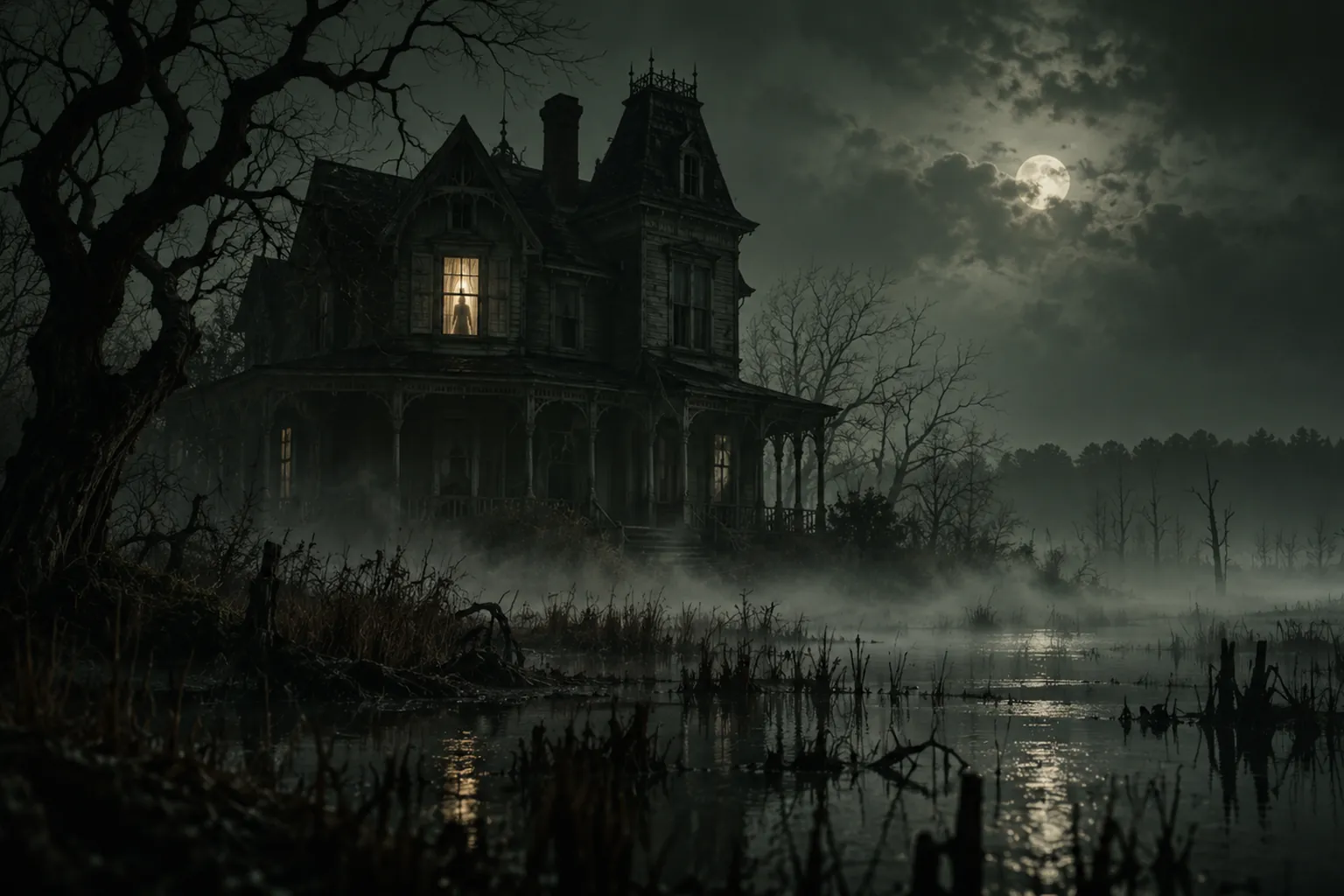
Gothic
Old houses and older families. A rich, formal narrator and voices that fit the period suit the slow build of a haunted inheritance.
Horror audiobooks
Good horror audiobook narration rarely shouts. It keeps a steady, almost comforting voice while the story goes wrong, then lets a whisper or a held breath do the damage. Upload your novel or story collection, cast the narrator and every voice in the dark, and place each whisper exactly where you want it.
EPUB, PDF, DOCX, TXT or MD · up to 30 MB
Read in your browser. Nothing is uploaded until you generate
Fear works differently in audio. A reader can glance ahead to check whether a scene is safe; a listener cannot. The narrator decides when the next sentence arrives, and that control over time is the strongest tool a horror audiobook has.
That is why so many effective horror narrators sound calm. A warm, measured voice describing something terrible opens a gap between tone and content, and listeners fill that gap with dread. A narrator who performs terror from page one has nowhere left to go when the real scare comes.
The characters are the opposite. Victims can be frightened, monsters can sound wrong and a stranger can be a little too friendly. The contrast between a steady narrator and the unsteady voices around it is what makes horror narration feel alive. For techniques that keep those voices apart, see how to do character voices.
The horror line-up pairs Brian, a deep, resonant and comforting narrator, with Aria as a sultry stranger and Spuds Oxley as a wise, approachable old caretaker. Trust neither of them. Tap a role to hear it.



A deep, comforting narrator that makes the quiet parts worse, and two strangers you shouldn’t trust.
Premium voicesTap a role to hear its voice.
Most scares follow the same shape. Direct the beats rather than every line, and the scene keeps its rhythm in the finished horror audiobook.
| Beat | Narration | Example direction or tag |
|---|---|---|
| The ordinary | Relaxed and warm; nothing is wrong yet | None |
| The first wrong detail | A little slower, in the same calm tone | [a little slower] |
| The build | Short sentences on separate lines, with breath between them | [breathe] before the next line |
| The scare | One line, either close and quiet or short and sharp | [whisper] or [terrified] |
| The false relief | A beat of ordinary warmth just before the real scare | [relieved, almost laughing] |
| The aftermath | Back to calm, which is somehow worse | [flat, exhausted] |
Inline sound tags such as [whisper], [breathe] and [sigh] work on the Standard, Lite and Expressive models, not on Premium. Expressive voices are the strongest at whispers and gasps; the AI voice emotion tags page lists more tags.
Play a line to hear inline tags performed mid-sentence, each word lit as it is spoken. In horror audiobook narration, one well placed [whisper] does more than a page of adjectives.

Nate
excited delivery
[say excitedly, like sharing big news with a friend]
Guess what? We actually did it. [laugh] The whole thing launches tomorrow morning!

Luna
whisper delivery
[in a hushed, breathy whisper, like sharing a secret in the dark]
Come closer. [breathe] I'll tell you where the old lighthouse keeper hid the key.
Rupert
anchor delivery
[say like a confident, authoritative news anchor, crisp and measured, stressing the key words]
Markets opened higher this morning, as investors welcomed news of a long-awaited trade agreement.

Nadia
ad delivery
[say warmly and cheerfully like an upbeat radio ad, smiling through every word]
Fresh bread, real coffee, and a table by the window. Your morning starts at Rosie's Corner Bakery.
The horror audiobook narrator you want depends on where the fear comes from. These pairings are starting points; recast any role after the first chapter.
Old houses and older families. A rich, formal narrator and voices that fit the period suit the slow build of a haunted inheritance.
The threat is too large to describe. A scholarly narrator who sounds less certain as the book goes on beats any monster voice.
Villages, rituals and smiling neighbours. Warm regional accents for the locals make their hospitality feel like a trap.
Diaries, letters and transcripts. Give each document’s date or heading a line of its own, and let the narrator read the rest as written.
Faster narration, short lines and real panic. Expressive voices handle screams and gasps best, if the book is short enough to afford them.
Listeners come back for the narrator. Keep one voice across every story or episode and recast only the characters.
Horror narration depends on timing, and timing starts in the text. A paragraph break is the cleanest pause you can give a voice.
Novella or novel. A 30,000 word novella runs about three and a quarter hours. With Standard voices that is roughly $30 to $40; with Expressive voices, about $105 to $150, a fair price for a book that lives on whispers. Compare tiers for your own word count with the audiobook cost calculator.
Classic horror. Older classics such as Poe’s tales or the ghost stories of M. R. James are in the public domain in many countries, which makes them good practice material. Check the status where you live, then try the public domain audiobook maker.
Channels and podcasts. Horror story narration has a large audience on video and podcast platforms. Export one MP3 per chapter for episodes, read make an audiobook on YouTube for rights and AI labelling, and check each platform’s current policy.
Hear it first. Upload a story to the AI audiobook generator and the cast is detected at no cost. New accounts created with Google get credits for a short sample, enough to judge whether the horror audiobook narrator is unsettling enough before you commit.
Patience and control. The best voices for horror stay calm and close, slow down slightly as tension builds and never oversell the scare. Deep, comforting narrators work well because the warmth makes the content more disturbing. Test your shortlist on the quietest scene in the book, not the loudest.
Yes. Start a line with a [whisper] direction or place a [whisper] tag inline. Inline tags work on the Standard, Lite and Expressive models, and Expressive voices give the most convincing whispers, breaths and gasps. The Premium model ignores bracket notes of both kinds, so avoid it for a heavily directed book.
Not as audio effects. Tags shape how a voice performs a line, such as a sigh or a whisper, but the studio does not mix in sound design. If you want effects or music, export the chapters as MP3 and add them in an audio editor afterwards.
Pick the most unusual voice left in the library and keep it slow. A direction such as [low, unhurried] or [too calm] usually unsettles more than a growl. Make sure its speech sits in quotation marks with a tag, or it will be read by the narrator.
Slower than most fiction. Most audiobooks run at 150 to 160 words per minute, and horror audiobooks benefit from staying near the bottom of that range in the build-up, then slowing again before a scare. Short sentences and paragraph breaks create that pace better than asking a voice to drag.
Very. Each story can be its own chapter, so the M4B gets a named marker per story and the MP3 export gives one file each. Keep the same narrator across the collection and give each story’s characters fresh voices, so every tale feels new while the host stays familiar.
Try horror audiobook narration on your short sample for free, whispers and all. No card needed.