Eyes and ears on one line
Reading while the same sentence plays gives two ways back in when your mind wanders. Many readers say it helps them stay with a dense chapter.
Listen while you read
If a page of print slips away halfway down, listening can be an easier way in. Make audiobooks for ADHD readers from the books, readings and PDFs you already have: tracks short enough to finish in one sitting, a distinct voice for each speaker, and the text open beside the audio so you can read and listen at once.
EPUB, PDF, DOCX, TXT or MD · up to 30 MB
Read in your browser. Nothing is uploaded until you generate

This turns text into audio. It is not a medical product, a treatment or a substitute for support from a clinician, a school or an employer. People with ADHD differ: some find listening easier than print, some find it harder, and many like a mix. Try one chapter of something you actually need to read and judge for yourself.
Upload a DRM-free EPUB, a DOCX, a text-based PDF, TXT or Markdown, up to 30 MB, or paste a few pages. Parsing runs in your browser.
Headings become track breaks. In pasted text, add a line such as “Part 2” every 1,500 to 2,500 words to get tracks of about 10 to 16 minutes.
A narrator you like listening to makes a bigger difference than any setting. Audition a few, and keep a separate voice for each character in dialogue.
Download one MP3 per track, or an M4B that remembers your place, and follow along in the book, the PDF or your notes.
None of these is a rule. They are habits listeners describe, to try and keep or drop.
Reading while the same sentence plays gives two ways back in when your mind wanders. Many readers say it helps them stay with a dense chapter.
A walk, the dishes or a commute can pair with a chapter. Some people find their focus is better when their hands or feet are busy.
A 12 minute track is one clear thing to finish. A row of finished tracks is easier to see than a bookmark stuck on page 140.
When each character has a different voice, you can tell who is talking without tracking quotation marks and tags.
The voices read at a typical audiobook pace, around 150 to 160 words a minute. Most players let you speed it up for a review or slow it down for a hard section.
Audiobook apps remember where you stopped in an M4B, and each chapter keeps its title, so a break does not mean starting over.
 Same cast in every book
Text with no headings is cut into parts of roughly 4,000 words, about 26 minutes each. That is fine for some listeners and long for others. To get shorter tracks, add a heading line such as “Part 3” or a Markdown heading such as “## Section 3” wherever you want a break, and each piece becomes its own file.
An EPUB uses its own table of contents, and a Word document splits on Heading 1 and Heading 2. If a chapter is still long, paste it in sections. The audiobook chapter length guide covers what most listeners find comfortable.
Play a few samples. A voice that is pleasant to you, not just clear, is the one you will come back to tomorrow.

Full-cast AI audiobook




Transcript
Playlist
Start with the reading you keep putting off.
Start with something you want to read. The first track decides whether the habit sticks. A novel you have been meaning to finish is a better test than a dry chapter you are dreading, and it shows you which voices and track lengths suit you.
Read along, or just listen. Both count as getting through the text. Some people need the page in front of them, others do best with eyes closed or on a walk. Switch between the two depending on the material and the day.
Audiobooks for ADHD students. If you have an accommodation plan, ask your school which audio formats and services are approved before you make your own. The audiobooks for dyslexia page covers school texts and access in more detail.
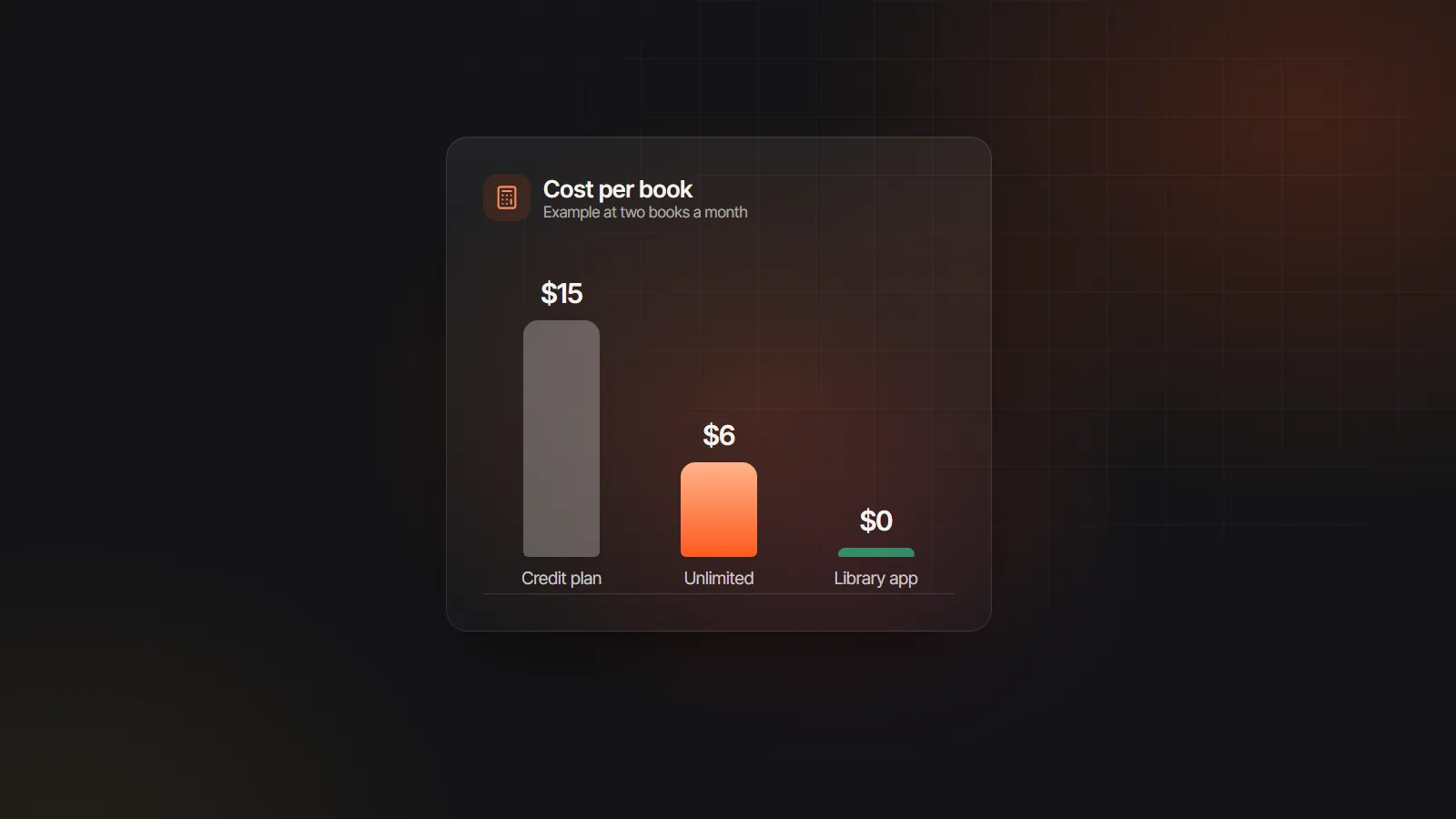
What it costs. A 20 page article of about 8,000 words is just under an hour of audio, roughly $8 to $10 with Standard voices and less with Lite. Importing and casting are free, and a Google sign-up comes with 100 gift credits (valid for 7 days, about 12 minutes on Standard; usage varies by text and voice tier) for a short sample, no card needed. Try it in the AI audiobook generator.
Rights and privacy. You own the audio you make from text you hold the rights to; for copyrighted books, read audiobook rights. Your files are read in the browser, only the lines you generate leave it for the speech model, and uploads never train AI models.
It depends on the person. Some people with ADHD find listening, or listening while reading, makes long texts easier to get through; others prefer print. Audiobooks for ADHD readers are a format choice, not a treatment. The practical test is to try a chapter of something you need to read and compare it with reading alone.
Neither is better for everyone. Reading along keeps the words in front of you and suits dense material; listening alone suits walks, chores and stories. Since every track matches a chapter or section of the text, it is easy to switch between the two.
Yes, if the PDF has real text you can select. Text PDFs are reflowed, with page numbers and running headers dropped. Scanned PDFs are page images and cannot be read, because there is no OCR. Ask for a digital copy if you only have a scan.
For audiobooks for ADHD listening, many people like 10 to 20 minutes, about 1,500 to 3,000 words, but there is no right answer. Add headings where you want breaks and the text splits there. If a track feels long, split it smaller next time.
For books the school assigns, ask the school first, since it may already provide approved audio. For public domain books and materials the teacher wrote, you can make audio. For copyrighted books, check the rights before making a copy.

Try audiobooks for ADHD reading with one free short sample: upload a text, no card needed.