
Ideas at your level
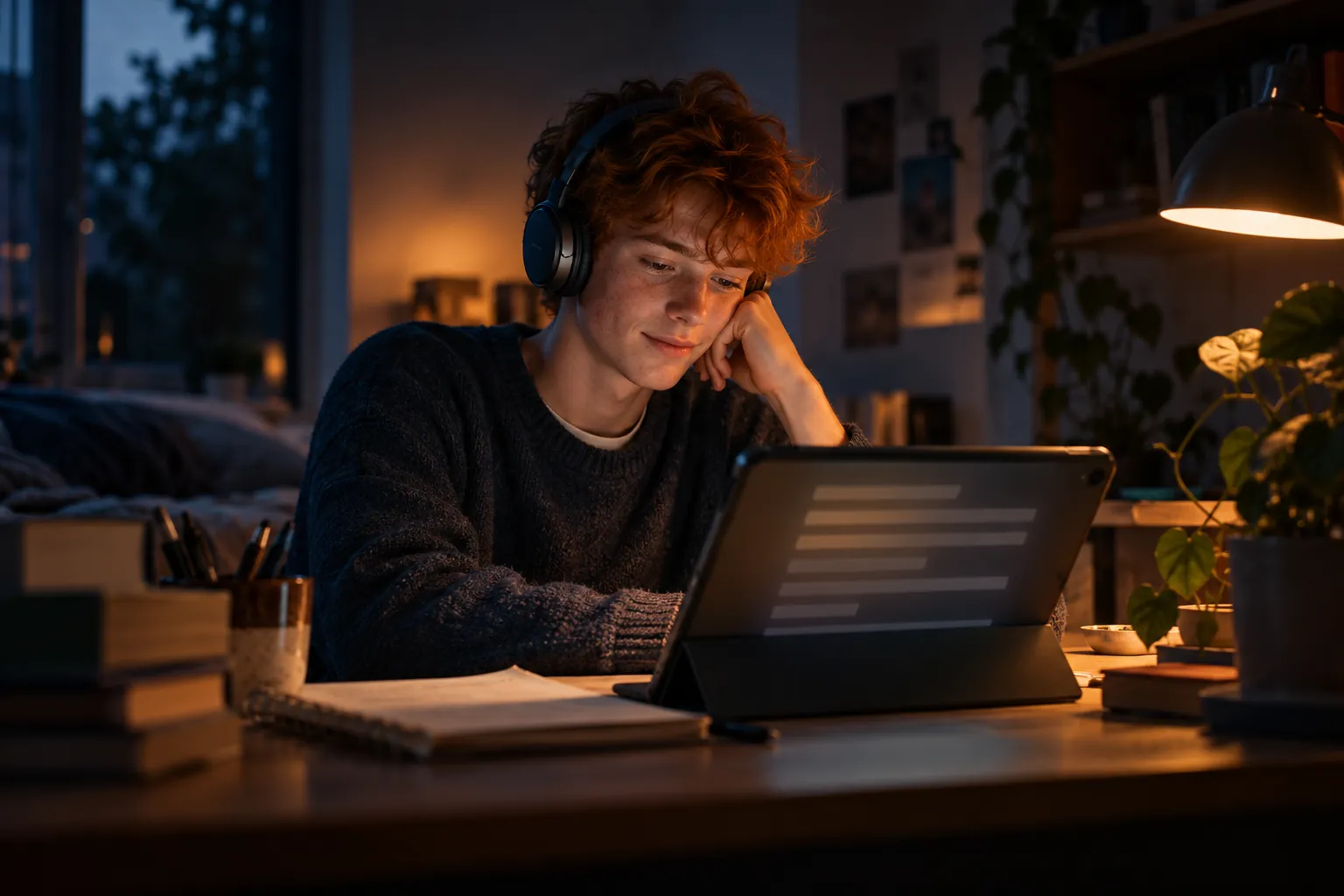
For many dyslexic readers, understanding runs ahead of decoding. Listening lets the ideas through at the level you think at.
Read with your ears too
Audiobooks for dyslexia usually exist for bestsellers and set texts, not for the handout from Tuesday’s class or the report your manager sent. Upload any readable text and get clear narration with a separate voice for each speaker, split into chapters you can follow line by line while you listen.
EPUB, PDF, DOCX, TXT or MD · up to 30 MB
Read in your browser. Nothing is uploaded until you generate
Services for print-disabled readers, such as Learning Ally or Bookshare in the United States and RNIB or Calibre Audio in the UK, may already have the title, often read by a person. Eligibility rules differ, so check with each service. Make your own audio books for dyslexia when the text is not there, or when you need it today rather than next month.
Making audiobooks for dyslexic students or adult readers takes four steps, and nothing costs credits until you generate audio.
Ask for the handout as a Word file or a PDF with selectable text. A photo or scan will not work, because page images cannot be read without OCR.
EPUB, DOCX, text PDF, TXT and Markdown files up to 30 MB open in your browser, or paste a passage. Chapters are detected from the contents or headings.
If a name or technical term is read wrongly, respell it in that line and regenerate just that line. The rest of the chapter stays as it is.
Save an MP3 for each chapter, or one M4B with chapter markers, then follow along in the original; the tracks line up with the chapters of the text.
Audiobooks for dyslexics do not treat dyslexia or teach reading. They change how the content reaches you.
For many dyslexic readers, understanding runs ahead of decoding. Listening lets the ideas through at the level you think at.
Make audio of the actual assigned reading, so class discussion is about the same text, not a simplified version.
Many readers find a 40 page reading far less tiring when they can listen to part of it and read the rest.
Names, terms and vocabulary are spoken aloud, so you learn how they sound alongside how they look on the page.
Each speaker in a conversation gets a voice of their own, which is easier to follow than quotation marks on a crowded page.
Paste an essay or a draft to hear missing words and repeats; text to speech for writers covers editing by ear.
What to upload and export for each situation that comes up most, from the classroom to the office.
| Situation | What to upload | What to export |
|---|---|---|
| Class handouts | The teacher’s DOCX or text PDF | One MP3 per handout |
| A public domain set text | An EPUB from Project Gutenberg or Standard Ebooks | An M4B with chapter markers |
| A college course pack | Text PDF from the course site | MP3 per chapter, or a ZIP |
| A report at work | A DOCX you are allowed to process | One MP3 for the commute |
| Your own essay | Pasted text | An MP3 to proof-listen |
PDFs are reflowed and page numbers dropped; see PDF to audiobook. Word files split on Heading 1 and Heading 2; see Word to audiobook.
 Same cast in every book
Novels set in class are full of dialogue, and long exchanges are where readers most often lose track of who said what. Each quoted line is matched to its speaker from the dialogue tag, and each speaker gets a voice of their own, with a narrator for everything else.
Up to ten named characters can be voiced per book, plus an “Other voices” role for minor speakers. Pick voices that are clearly different from one another, and keep a calm, steady narrator, since the narration carries most of the text.
Ask for digital copies early. Teachers can usually share a handout as a Word file, and college disability services can often supply accessible PDFs. A digital copy is the difference between a two minute upload and nothing, since scans cannot be read.
Work with the school’s process. If a student has an accommodation plan, follow the school’s route for approved audio formats and testing rules. This is a tool for making audio files; it is not an assessment, a diagnosis or a reading intervention.
For parents. Materials the teacher wrote, public domain books and your child’s own writing are all fair to turn into audio at home. For copyrighted textbooks and novels, ask the school or check the rights first; the classroom read aloud page explains the same rules from the teacher’s side.
What it costs. A 2,000 word handout is about 13 minutes of audio, roughly 103 credits with Standard voices or 68 with Lite, so the Starter plan’s 400 monthly credits cover four to six handouts. Importing is free, and new accounts created with Google get 100 gift credits (valid for 7 days, about 12 minutes on Standard; usage varies by text and voice tier) for a short sample in the AI audiobook generator.
Privacy. Files are parsed in your browser, the speech model receives only the lines you generate, and no upload is ever used for AI training.
For understanding and discussing a book, many educators treat listening as reading it, because you meet the same ideas, plot and vocabulary. For practicing decoding, it does not replace reading instruction. Plenty of readers combine the two, listening while their eyes follow the text.
Audiobooks for dyslexia do not treat or cure it. What they change is access: you can take in a text at your comprehension level without decoding every word first. Whether that helps you is personal, so try a chapter of something you need to read and see.
Not as it is. Photos and scans are page images, and there is no OCR here, so there is no text to read. Ask the teacher or colleague for the original Word file or a PDF with selectable text, or type the passage into the paste box.
Usually a calm, mid-pitched voice at an even pace, with little drama. Audition three on a paragraph of the actual reading. Narration runs at about 150 to 160 words per minute, and most players let you slow it down if you are reading along.
Yes. Uploading, chapter detection and casting are free, and you get free credits to generate a short sample when you sign up with Google, no card needed. Services for print-disabled readers are often free for eligible readers, so check those too.

Upload a text and try audiobooks for dyslexia free for a short sample, no card needed.